
anne fine

A Shame to Miss

I suddenly noticed how many young people I was coming across who loved reading, and claimed to like poetry, but who seemed never to have come across some of the best - and best-loved - poems for their age-group. Indeed, rather more than we would like to think had only ever been introduced to the more "jokey" sorts of doggerel. And even those who came across wider collections had still missed an awful lot of wonderfully appealing poems. It all seemed such a shame.

And that's when I decided to put together three collections of poems it would be "A Shame to Miss". The first is for children of 6 - 10, the second would be perfect for anyone in between 8 and 12. And the third is a rather more demanding collection of poems that have a particular interest or appeal to early and middle adolescents.

In the two younger collections I've added, as easy-going footnotes, anything I think a young reader needs to know to "get" the poem first time. I know I'll be handing plenty of copies about - and I'm not quite sure yet whether it's because I care about children or I care about poetry. I suppose it must be a mix of both.
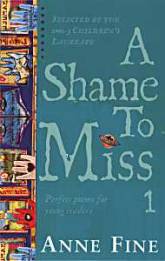
The cover of 'A Shame to Miss 1', illustration by Sue Clarke

Cover illustration: Sue Clarke

' Many young people come to poetry through someone older with a passion for it. Others have to manage by themselves, and it can be difficult.

I still remember exactly why it was I didn't 'get' lots of the poems I came across. I remember which words I didn't understand, and even which bits I couldn't follow because of things no one had told me.

I've chosen these particular poems because, if I were your mother or teacher, these are the ones I really wouldn't want you to miss. And I've tried to explain everything you need to know to enjoy them first time.'

Anne's signature


A Shame to Miss 1 was published on August 5th 2003; ISBN: 0-552-54867-7

Order A Shame to Miss 1 from Amazon.


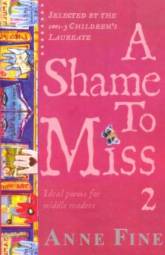
The cover of 'A Shame to Miss 2', illustration by Sue Clarke

Cover illustration: Sue Clarke

' It was a whole lot easier for people my age to come to know, and even enjoy, whole reams of poetry. For one thing, our grandparents were forever spouting great chunks of their own favourites as we sat on their knees. (I'm not kidding.) They'd been forced to learn them at school or in Sunday school, either as homework or as punishments. And they were often still word perfect half a century later. One of my grandmother's party tricks was to make my poor mother weep buckets - even at forty years old - by reeling off some dismal Victorian tear-jerker about a family so poor that they had to give away one of their children, and were trying to decide which one to choose. (I've spared you that one.)

I've chosen poems people your age find it easy to like. The more you say a poem aloud, the easier it is to 'unpick it' to see what it means, especially if you pay attention to the punctuation. And sometimes I've put something by the poem, so you'll understand what it's about a little more quickly.

Go on. You might enjoy them.
Millions do. They can't all be pretending. '


Anne's signature


A Shame to Miss 2 was published on August 5th 2003; ISBN: 0-552-54868-5

Order A Shame to Miss 2 from Amazon.


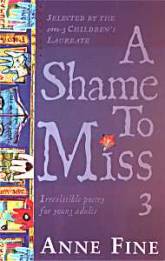
The cover of 'A Shame to Miss 3', illustration by Sue Clarke

Cover illustration by Sue Clarke

' What I've done here is to pick the poems young people seem to like best. Show the collection to adults and half will be stabbing the odd page muttering, 'This one's a bit unsuitable, isn't it?' and the other half will be reeling round the room clutching their heads, wailing, 'What only one Keats sonnet? Only one?'

Ignore them. See what you think. Remember that some of the more old-fashioned poems are easier to enjoy if you decode them first. Take Wordsworth's On Westminster Bridge:

Earth has not anything to show more fair:
Dull would he be of soul who could pass by
A sight so touching in its majesty:
This city now...

Translate that into, say,

Champion view!
You'd have to be a stone to walk past that.
Breaks your heart, dunnit,
London...

and you'll begin to see why Wordsworth has the edge on the average hungover dawn homegoer leaning over a parapet.

You read a poem. Some images and phrases stick, and from that moment you can see flashes of the world through that poet's eyes. Practically every adult you know says every November, "It's getting dark so early." You don't think twice about it. then you read E.J.Scovell —

The days fail. The night broods over afternoon.

— and the poet's way of putting it haunts you. You see what's happening in a richer way.

In her autobiography To the Island, Janet Frame describes the magical effect of her private reading at this age as:

...the other world's arrival in my world - the literature streaming through it like an army of beautiful ribbons through the branches of a green growing tree, touching the leaves with unexpected light.

One thing to bear in mind is that you often don't fully 'get' a poem until a long time after you first come across it. You may study or even learn it by heart - usually because someone makes you. But only when you fall in - or out - of love, lose someone, travel, can't sleep for a week, stand in a snowstorm, get bitten by a dog or whatever, do the chosen words spring to mind. Now you can truly understand how brilliantly the experience was captured.

So try to think of some poems having, like flu medicines, a kind of timed release. Take even those on trust. I promise you, you won't be sorry later. '


Anne's signature

A Shame to Miss 3 was published on August 5th 2003; ISBN: 0-552-54869-3

Order A Shame to Miss 3 from Amazon.


The Scotsman Review

"Making children think poetry is "cool" is almost as difficult as convincing them of the absolute necessity of recorder practice. It can be done, but not by the likes of normal parents.

"Which is precisely why we need children's laureate Anne Fine. Her three-book selection of poems, A Shame to Miss, published this week by Corgi at £4.99 each, is as warm-hearted and unpretentious as she is herself.

"Carefully aimed at three different age ranges - juniors, young adults, and the elusive 9-11s in between - the selection is also marvellously eclectic. The notes offer not only necessary explanations but engaging quirkiness throughout. Of And Did Those Feet in Ancient Time she notes: 'Blake's poetry is 'mystical' (religiously weird) ... Most people know this as a hymn, and sooner or later you'll have to sing it at someone's funeral.' A sad amen to that."

The Browser in The Scotsman


Writing in Education review

"Anne Fine is like the best kind of parent or teacher who provides just enough information to make poems comprehensible to young readers but otherwise lets the poets speak for themselves. Her comments feel intimate and personal but never patronising ("this is what we call a spoof or parody", a soliloquy is "talking to yourself out loud"). Definitions are given for unusual words - the footnote to George Barker's The Cheetah, My Dearest, Is Known Not to Cheat describes a mandrill and adds "I'm afraid George has spelt it wrong" - a respectful, authoritative comment which serves to make the process of poem-making and reading more interactive and interesting."

Victoria Field
