

MY HOME LIBRARY
In 2002, Anne Fine celebrated World Book Day by launching a unique project to encourage children across the UK to make their own library and get reading. Here's an article she wrote at the time for Books for Keeps:
Show me the young reader who's never laboriously penned it all in the front of a favourite book: their full name, street, city, country, then, with gathering grandiosity, 'World, Solar System, Universe'. When I was eight, we moved to a tumbledown house. My father finally got round to prising the lock off the door to the cellar, and down there we found a trunk stuffed with mildewed London Illustrated Magazines and novels by Thackeray. In the front of each was a personalised book plate: "ex libris Viscount Molesworth". Oh, how I envied him.
Envy and Eavesdropping
But I'd never guessed it would be a combination of this failing - envy - and yet another - eavesdropping - that would lead to my project as Children's Laureate. I first heard the expression home library during a Children's Literature conference at Keene State University. A writer famous for his African Tales was talking about visits he still made to schools in the poorest area of New York City, where he'd been raised.
'Each sort of library serves a special purpose' I recall him saying. 'National, state, city, street, school and class. But it's so important not to stop there. Everyone needs at least some books of their own. I tell the children "Don't matter how poor you are. Always be looking out for something you'd like in your home library."
Over the years, his words came back to me each time I met a child from a bookless home, or a teacher or librarian who spoke of the pleasure so many children take in being offered their first ever 'book for keeps'. With so many gloriously attractive books around, I couldn't help thinking: what would it take to make sure all our young people could lift something they might want to read off a shelf in their own bedroom?
But 'Books in the Home!' seemed such a dangerous rallying cry during the eighties and nineties, when public libraries seemed so much under threat.
Book ownership
Times have changed. Not only can we now be confident that essentially free access to libraries will remain an integral part of our culture, but librarians themselves have come to recognise that book ownership and book borrowing support one another. And other attitudes have shifted too. Twenty years ago, one astute bookseller pointed out that whereas American parents thought books for their children were a grand idea, and so were willing to make sacrifices to buy them, the equivalent British parent was frequently of the opinion that, if books were so important, then someone else should be providing them.
For better or worse, this belief's long gone, along with the patterns of life and work that made the library so accessible to people of my age in childhood. We heard it all the time. 'If you want something to read, go to the library.' As young as seven, I used to step out confidently with last week's two issues tucked under my arm, to wait at the crossing till the traffic stopped, change my books and come home again safely.
Now, with high speed roads, police car chases, closing branch libraries, and fears about child molestation, this picture has become as old-fashioned and unlikely as an illustration from an early Ladybird reader.
But someone like me, who feels she owes pretty well everything to the reading on offer through childhood, can't help but fret about those growing up without that basic bridge to self-development. For years I've thought there had to be some way of getting children to think in terms of sagging bookshelves as well as bulging clothes closets and overflowing toy chests.
Bookplates
Then, one day, staring at one of Molesworth's enviable book plates, everything fell in place. Why not cash in on every child's desire to choose their favourite, stick a label on something, write their name on a possession?
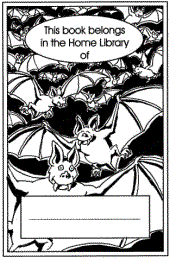
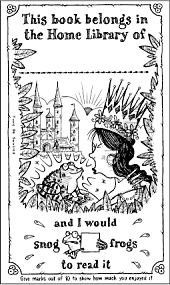
Bookplates! Fresh, modern bookplates. free. Accessible through schools and reading groups and off the web. After all, if you print off a bookplate by Korky Paul and another by Nick Sharratt, and you only have one book, what are you going to do?
Find another book, quickly.
And it needn't be expensive. Most schools have jumble sales. Most children walk past charity shops. (Last year, Oxfam alone sold four million pounds worth of second hand children's books.) And the less privileged the area, the more charity shops there usually are. It was this final thought that clinched the matter for me. This could be made to work.
So that's the plan. For starters, we asked twenty-one of our finest (and busiest) line illustrators to design us a black and white bookplate, free. They have all been astonishingly generous. First in were plates from Quentin Blake, Shirley Hughes, Debi Glori, Posy Simmonds and Philippe Dupasquier. Then Tony de Saulles's and Raymond Briggs's designs arrived. And it's gone on and on.
We have bookplates of all sorts, to appeal to all ages. We have cosy, funny, sporty, magical, weird, disturbing, fantastical, moody - even downright unpleasant. We chose black and white for these first plates because it's cheaper to copy and download. Soon every school in the country will have a starter template for free photocopying (for all except commercial purposes). And it's a roll call of names that will make everyone take notice.
The idea is that, once the old passion for bookplates has been rekindled, everyone will pitch in. Think of it. Authors and Illustrators with bookplates featuring their own characters and styles on their own web sites as well as on ours (www.myhomelibrary.org). Football clubs with bookplates in their colours. Schools holding bookplate design competitions. (We have teachers already pouncing on this idea.) Irresistibly glossy plates bearing the names of the bookshops that offer them. Bookplates for bribes and rewards in school. Some black and white, some in full colour, but as many as possible bearing the words:
This book belongs in the Home Library of
because what underlies the scheme remains the hope that every child from no matter what background would have at least some books of their own, be it the publishers's son with his fitted hand-tooled bookcase filled with signed first editions, or the child in care lugging her cardboard box decorated with used wrapping paper from one temporary home to another.
Something for your Home Library...
I'd hope the expression would become part of the language with Granny handing over a novel, 'Here's something I thought you might like for your home library,' and teachers saying, 'And the winner gets a book for their home library.' Books can be swapped and passed on. All it will take to make a book new to its next owner is a freshly chosen bookplate. The plan meshes easily with the work of all the people and organisations already committed to bringing books to children. And anyone is free to pick up the idea and use it any way they choose.
Will it lead to more reading? I hope so. And to encourage that, a lot of plates have been designed so that the child can award the book marks out of ten. (Hey! Before you shudder, remember: whatever works!)
If I'm quite honest, I was really relieved when, first time around, it was Quentin Blake who was chosen as Laureate. I had books in mind - now written. At the end of a long two-year work haul - All Bones and Lies, Up on Cloud Nine, Notso Hotso and Stories of Angus and Jamie - I felt like a piece of chewed string. This time, when Lois Beeson, administrator to the Children's Laureate, phoned to ask, 'Are you in or out?', it only took a moment, 'I'm in.' For, as it happens, I'd just been reading Charles Dickens's passage from Hard Times:
The poor you will always have with you. Cultivate in them, while there is yet time, the utmost graces of the fancies and affections to adorn their lives, so much in need of ornament. Or, in the day of your triumph, when romance is utterly driven out of their souls, and they and a bare existence stand face to face, reality will take a wolfish turn, and make an end of you.
There's more than one way of being impoverished. More books for all: that's the idea of the Home Library. Please help it happen.